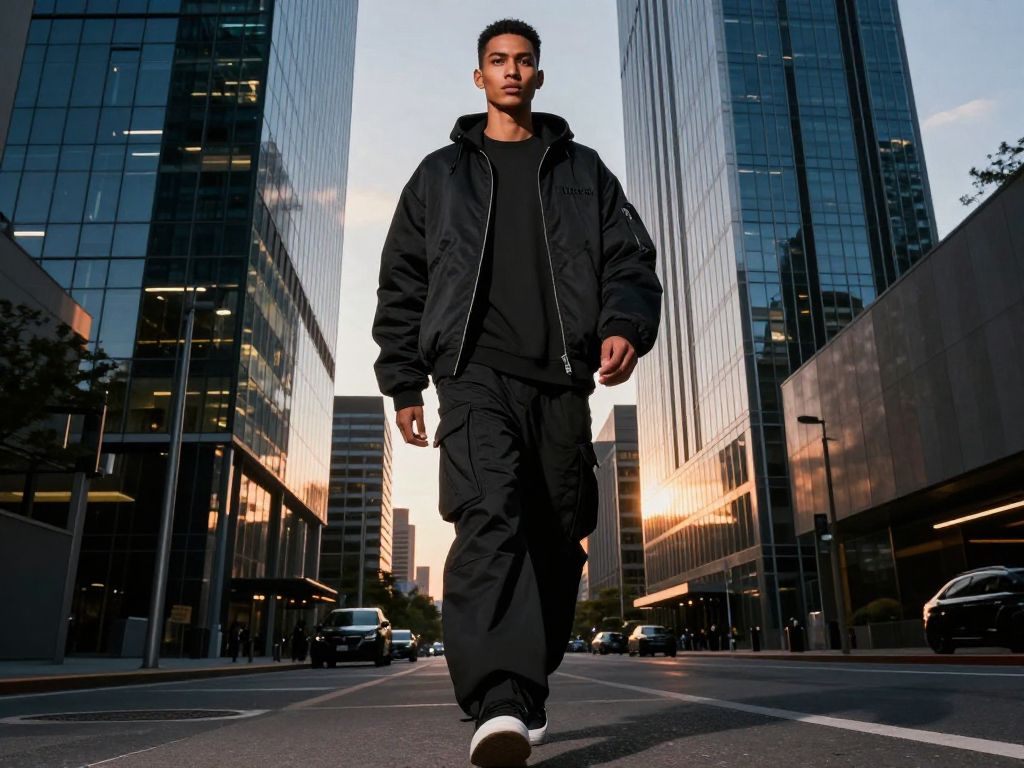
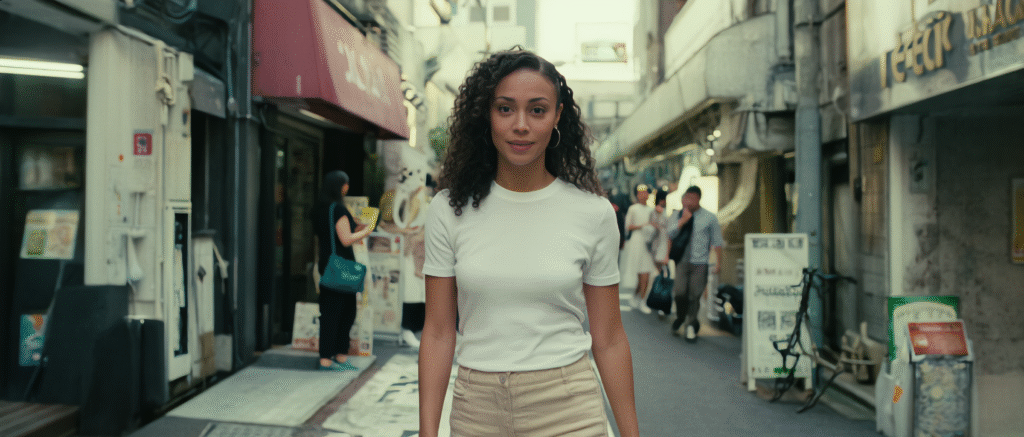
Zalando, one of Europe’s largest fashion retailers, cut its content production costs by 90% using AI. Not thirty. Not half. Ninety percent! Production time dropped from six to eight weeks to three to four days. AI fashion photography isn’t a future trend to watch. It’s already running the product pages of some of the world’s biggest fashion brands.
If you’re still organizing expensive photoshoots for every collection drop, you already know the problem. They’re slow, expensive, and logistically exhausting. And the output is never quite enough, because the moment a shoot wraps, you need more content for ads, social, and the next product launch.
In this post I’ll break down exactly what AI can replace, what the numbers actually look like, and how to do it in practice, starting today, with nothing more than a product image.
Why fashion photoshoots are so expensive
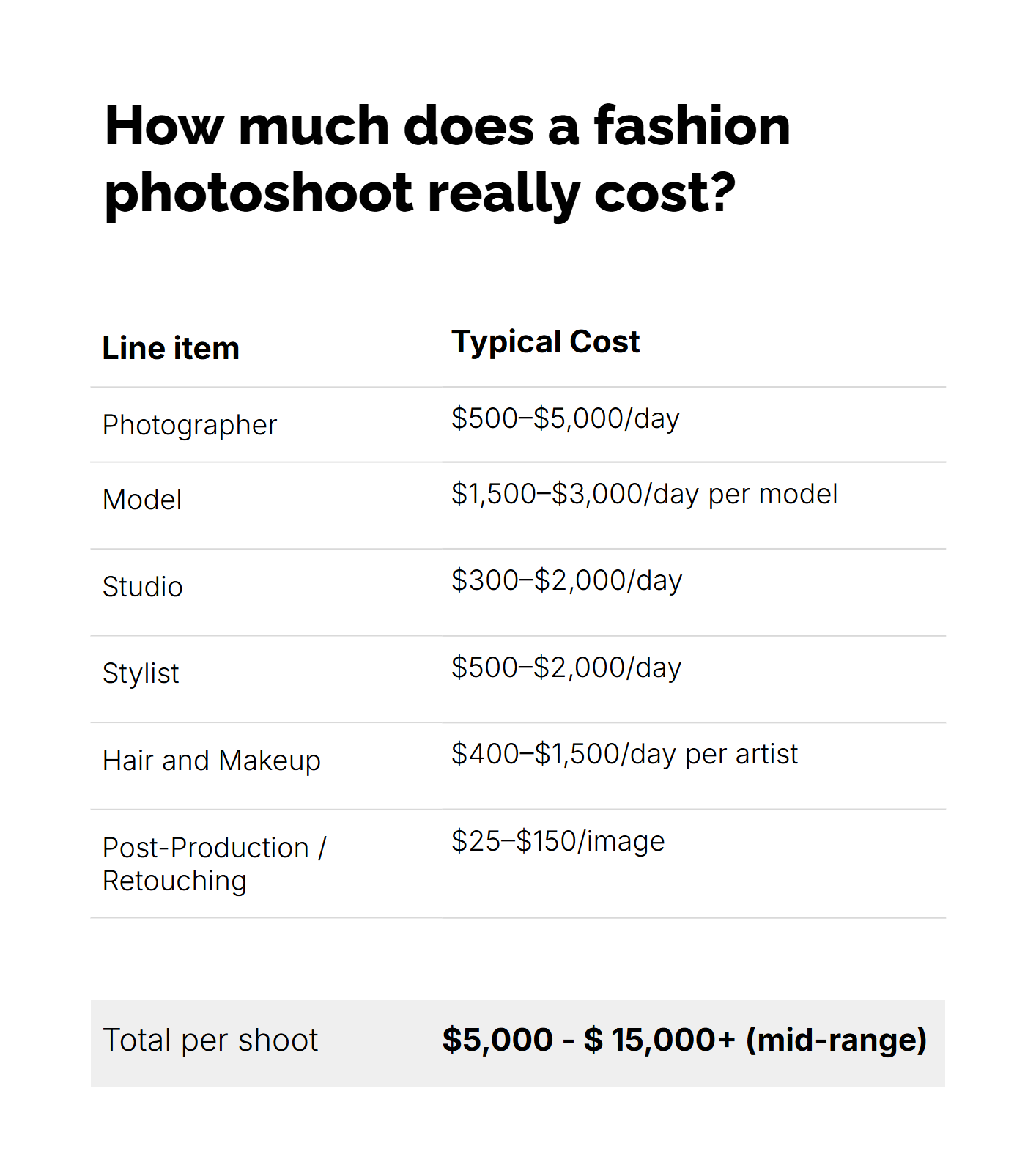
The real cost of a fashion photoshoot hits hardest when you itemize it. Most brand owners think in day rates, but the per-image cost tells the clearer story: $150 to $1,500 per final retouched image from a mid-range shoot. How much does a fashion photoshoot cost — complete price breakdown
A mid-range shoot with professional models, a rented studio, a stylist, and a retoucher runs $5,000 to $15,000. A high-end campaign shoot for a larger brand can exceed $25,000 to $50,000 per day. Even a budget shoot with a minimal crew starts at $1,500 to $4,000, and that’s before you’ve paid for post-production or accounted for the weeks of briefing, scheduling, and approvals that get you to shoot day.
Here’s where that budget actually goes:
With every new collection comes another expensive photoshoot. You might have guessed that that’s why alternative more affordable alternatives are being explored. In comes AI.
What AI can (and can’t) replace in a fashion photoshoot
AI doesn’t replace everything (yet), and saying otherwise wouldn’t be honest. But the range of photoshoot work that AI fashion photography handles well is wider than most people assume, and it covers most of what takes up the largest share of the budget.
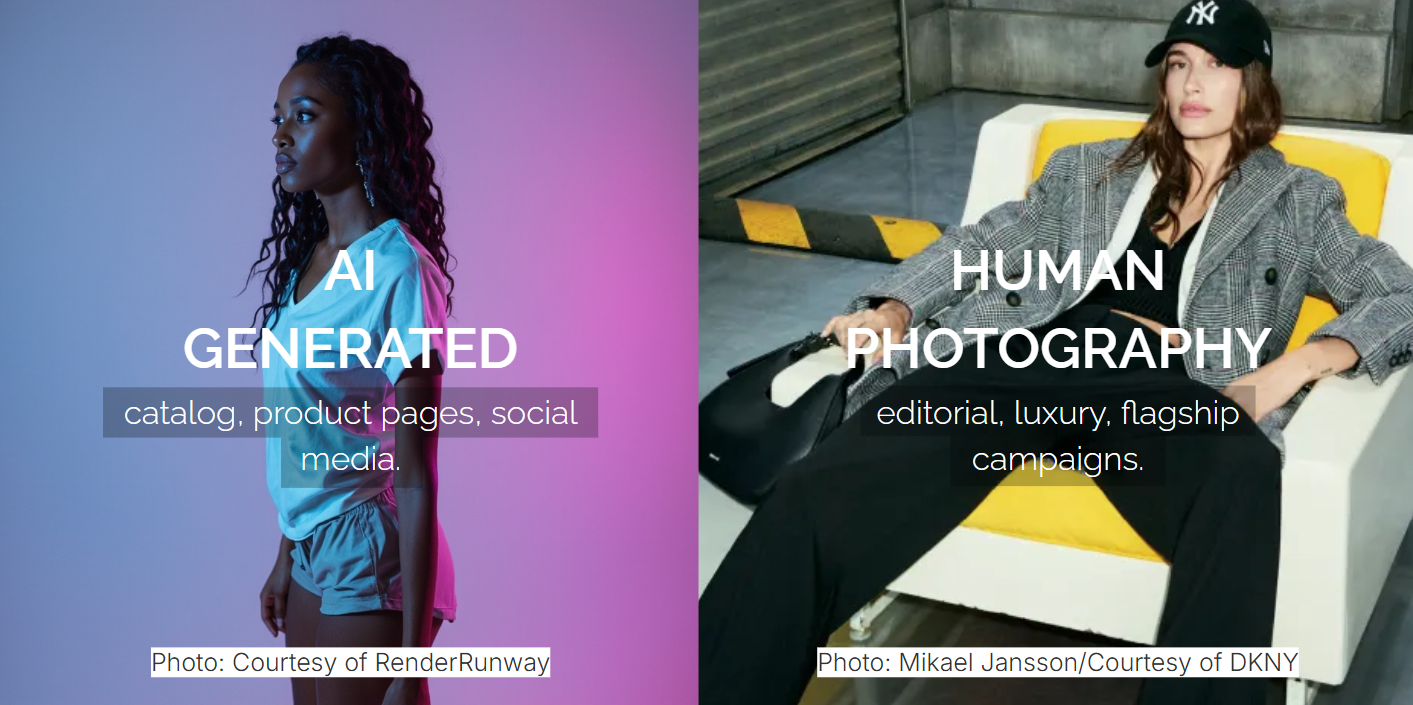
So when considering AI it’s about understanding which types of imagery you’re producing. For high-volume, repeatable work, catalog shots, on-model product imagery, background variations, and social media content, AI fashion photography is already the faster, cheaper, and more scalable option. For flagship campaign editorial and high-fashion storytelling where the brand’s visual identity is on the line, human photography still has a clear advantage. The hybrid approach is the mainstream reality in 2026, and it’s worth being clear about that. [NOTE: It’s this writer’s opinion though, that true creatives ( the ones that like pushing the boundaries) will likely experiment with this space sooner rather than later. But for now, adoption of AI models is still developing, so focusing on the low-hanging fruit is the logical place to start].
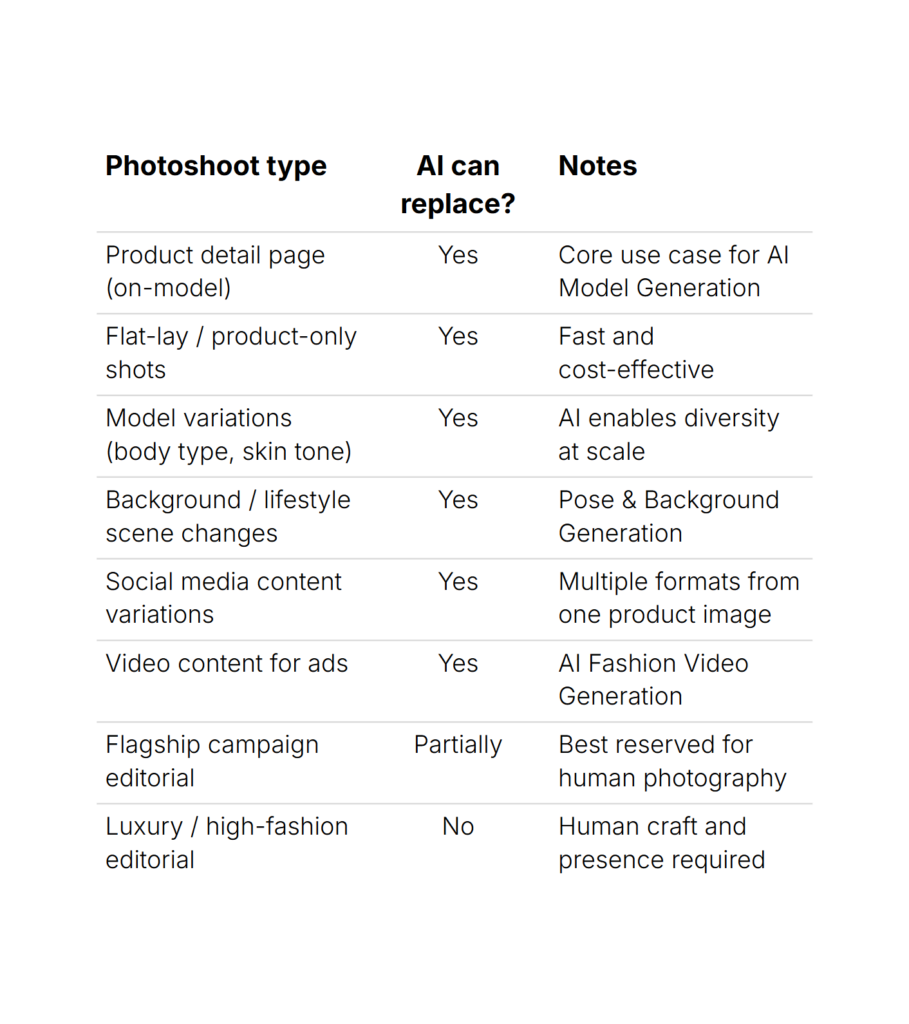
Think of AI fashion photography as part of a smarter production mix. Use it for the content that needs speed, scale, and variation, and save traditional shoots for the moments where texture, physical presence, and a photographer’s creative eye really matter. Your team spends more time on creative work, and your budget stretches a lot further. Whether you are a sole entrepreneur, a boutique of a major apparel brand, AI models could be for you. Let’s look at some companies who’ve already done some of the groundwork here.
The brands already doing it
The hesitation most brands feel about AI imagery, “Is it really good enough?”, is easier to settle when you look at who’s already using it. Let’s have a quick look at 4 examples of companies who succesfully apply AI-fashion.
Zalando 70% of editorial images AI-generated, 90% cost reduction.
Zalando didn’t just test AI imagery. By late 2024, 70% of their editorial images were AI-generated, and the program cut their content production costs by 90% while shrinking production timelines from six to eight weeks down to three to four days. Zalando’s VP of Content Solutions confirmed publicly that traditional photoshoots remain part of the mix, but that AI handles the volume work that previously consumed most of the production budget. Zalando uses AI to speed up marketing campaigns and cut costs
Zara’s production time cut from 11 days to 48 hours.
Zara moved just as decisively. In December 2025, Zara reduced average production time for e-commerce photos from 11 days to under 48 hours after implementing AI workflows. For a retailer running that many product lines at that pace, that kind of speed isn’t a nice-to-have. It’s a competitive requirement. Zara turns to AI to generate fashion imagery using real-life models
Mango’s first fully AI-generated fashion campaign
Mango went further with a specific campaign. The Spanish retailer launched its teen line “Sunset Dream” collection in mid-2024 built entirely with generative AI, from the models to the backgrounds to the overall visual direction. It was the first fully AI-generated fashion campaign from a brand at that scale, and it ran without incident. AI models replace real people in Mango’s fast-fashion ads
H&M’s Digital twin models: one model, hundreds of product images.
H&M took a different approach. The brand created “digital twins” of real models, AI replicas that can be dressed in different outfits without a physical reshoot. One model, hundreds of product images, zero additional shoot days. H&M releases first images with AI digital twins
These aren’t early adopters anymore. According to Morgan Stanley, AI adoption in consumer and apparel companies rose from 20% to 44% in the first half of 2025 alone. The AI-generated fashion photography market reached $2.01 billion in 2025 and is growing at 32.5% per year. The brands producing AI-generated fashion images at scale today are no longer outliers. They’re setting the new production standard. The beauty of it all, AI-generated fashion isn’t only accessible to the big established brands, but to anyone at a fraction of the cost.
The cost comparison: traditional photoshoot vs. AI
The per-image numbers make the business case for AI fashion photography straightforward. Traditional fashion photography costs $150 to $1,500 per final retouched image. AI product photography for fashion costs approximately $0.50 to $5.00 per image on most platforms. AI vs. traditional photography — complete cost comparison
At scale, the difference compounds fast. A collection requiring 200 images costs $30,000 to $300,000 to shoot traditionally. The same 200 images via AI cost $50 to $500.
| Cost factor | Traditional photoshoot | RenderRunway |
| Cost per image | $150–$1,500 | $0.04–$0.20 per-image* |
| Setup and production time | 3–8 weeks | Minutes |
| Model variations | Cost per additional model | Included — unlimited styles |
| Background changes | Requires reshooting | Instant |
| Minimum viable budget | $1,500–$5,000 | From $9.99–$49.99/month |
| Scalability | Linear cost growth | Near-zero marginal cost |
* Prices based on starter plan [march 2026] and all image generation models.
The number that changes the conversation for most brands isn’t the day rate. It’s the last row. Traditional photoshoots scale linearly: more images means more cost, every time. AI fashion photography is near-zero marginal cost once you’re on the platform. The tenth image costs the same as the thousandth. As I am writing for RenderRunway, it’s obvious to next have a look at how RenderRunway can support you in your AI photoshoot
How to replace your next photoshoot with RenderRunway
Think of RenderRunway as your always-available fashion studio, minus the lighting setup, makeup team, and scheduling headaches. Here’s exactly how to use it.
- Step 1 — Generate your AI model
Use AI Model Generation to place your garment on a photorealistic AI model. Choose the model style, body type, skin tone, and pose that fits your brand. This is the step where the traditional model booking cost disappears entirely. - Step 2 — Create outfit and pose variations
Use Multi-Pose to create multiple poses from a single model generation. You get the full range of angles a product page needs, front, back, three-quarter, lifestyle, in one session rather than across multiple shoot days. - Step 3 — Set your scenes with backgrounds
Use Pose & Background Generation (or Background Personalize) to place the model in different environments: clean studio, lifestyle location, seasonal setting, urban backdrop. Each scene variation costs nothing extra and takes minutes rather than another shoot day.
- Step 4 — Try on different looks
Use Virtual Try-On to test how the same AI model looks in different colorways, patterns, or garment styles. This is ideal for collections with multiple variants and for product page A/B testing where you want to compare how different versions perform with real visitors. - Step 5 — Extend to video
Use AI Fashion Video Generation to turn your best fashion visuals into short-form video content for ads and social media, without a video production crew, reshooting, or additional creative direction.
A full product shoot that used to take weeks to organize and cost thousands can now be completed in an afternoon. With AI, brands streamline the entire production process and remove the logistical friction that slows creative work down. The result is a full content calendar, a production budget that stretches further, and no more rescheduling because the studio was double-booked.
FAQ: AI fashion photography
How much does a fashion photoshoot cost?
A budget fashion photoshoot starts at $1,500 to $4,000 for a minimal crew. A mid-range shoot with professional models, a rented studio, a stylist, and retouching runs $5,000 to $15,000. High-end campaign shoots regularly exceed $25,000 to $50,000 per day. The per-image cost from a traditional shoot runs $150 to $1,500 per final retouched image. AI fashion photography brings that down to $0.50 to $5.00 per image, with platform subscriptions from $19 to $50 per month.
Can AI replace fashion photographers entirely?
No, and it’s worth being clear about that. AI fashion photography replaces the high-volume, repeatable work: product page imagery, catalog shots, model and background variations, and social media content. Human photography remains right for flagship editorial, runway, and luxury brand storytelling where physical presence and a photographer’s creative direction are the point. Zalando’s VP of Content Solutions confirmed this hybrid model publicly: AI handles volume, human teams handle prestige. Most creative teams end up freed to focus on the work that actually requires them.
How long does an AI fashion photoshoot take?
From product upload to finished fashion visual can take minutes. A full set of product page variations, multiple models, poses, and backgrounds, can typically be completed in under an hour. Compare that to the traditional timeline: three to eight weeks from initial brief to retouched final images. Zara’s real-world result is the clearest benchmark: they reduced production time from 11 days to under 48 hours after implementing AI workflows.
What types of fashion imagery does AI handle best?
AI fashion photography handles on-model product imagery, catalog shots, background and lifestyle scene variations, diverse model variations, and social media content particularly well. It also extends to short-form video for ads. The areas where human photography still leads are high-fashion editorial, runway campaigns, luxury brand storytelling, and any imagery where fabric texture and drape are the primary visual subject and a photographer’s creative eye is genuinely part of the product.
Is AI product photography good enough for Shopify?
Yes. AI fashion photography is already used by major retailers including Zalando, Zara, and Mango in published campaigns and product pages. For Shopify, the quality requirement is high-resolution, clean on-model imagery, which AI fashion tools deliver consistently at a fraction of traditional photoshoot costs. Many small brands and solo Shopify operators can’t afford professional photoshoots; AI product photography for fashion makes professional-quality visuals accessible from as little as $9.99 to $49.99 per month. Start your free trial on RenderRunway
What it all comes down to
The evidence is in, and it comes from brands you know. Zalando cut production costs by 90% and reduced lead times from weeks to days. Zara went from 11 days per product to under 48 hours. Mango built an entire campaign with AI. H&M created digital model replicas that can be dressed in new collections without ever booking a shoot day again.
AI fashion photography doesn’t replace everything, but it replaces most of what costs the most and takes the longest. Catalog imagery, model variations, background changes, social media content: these are the shoots that consume the majority of a fashion brand’s production budget, and they’re exactly what AI fashion photography handles best. The prestige shoots, the editorial campaigns, the runway imagery where human craft is the point, those stay.
Getting started requires nothing but a product image. No studio booking, no model brief, no post-production queue. See what RenderRunway can do for your next collection. View pricing and start for free